
DataDost AI

AI-ready data foundation

Real AI runs on a foundation that holds. We build that foundation.

Every AI initiative crashes into the data layer. DataDost AI builds the source contracts, tested pipelines, governed metrics, and handover evidence that make AI possible, before you commit to a model, a vendor, or a use case.

AI-ready data system

Source contracts
Tested pipelines
Governed metrics
Quality gates
Handover runbooks
340+

delivery artifacts

Connectors, models, dashboards, automations, runbooks, and QA packs designed since 2019.
98.7%

logged run success

Scheduled-run success across monitored pipeline and reporting jobs with available run logs.
6 weeks

first-release planning band

Typical planning band for bounded first releases with 3-5 sources and handover.
100%

closure evidence required

Accepted paid builds require source map, metric notes, QA notes, and runbook before closure.
0

unreviewed maintained incidents

Maintained incident log has no unreviewed production incidents.

Based on internal data.

The problem we solve

Board numbers should not depend on manual reconciliation.

Fragmented truth

Revenue, product, CRM, and campaign data live in separate systems. Board packs start with reconciliation instead of decisions.

DataDost response

We map the sources and define the contracts.

Silent failure

Dashboards break when exports, schemas, or ownership assumptions change. Teams discover the issue after the number is already in use.

DataDost response

We build monitored pipelines with QA checks and alert paths.

No handover trail

Grain, cadence, metric ownership, and recovery steps are undocumented. The stack becomes hard to trust and harder to inherit.

DataDost response

We document the metric layer and hand over practical runbooks.

Engagement models

Four serious ways to start the data work.

Start with a bounded pilot, a first trusted data stack, senior fractional capacity, or an AI-ready workflow tied to accepted data-system outcomes.

Pilot

Data Reliability Pilot

Prove one source-to-metric path.

A bounded pilot that proves one source-to-metric path with ingestion, quality checks, dashboard output, and a handover runbook.

Review scope
Starter

Data Stack Starter

Create the first trusted operating layer.

Source inventory, starter warehouse or analytics store, three trusted dashboard views, metric dictionary, and two weeks of hypercare.

Review scope
Retainer

Fractional Data Team

Add senior data capacity before hiring.

Senior data engineering and analytics capacity for teams that need pipelines, dashboards, metric ownership, and operating cadence before hiring.

Review scope
AI

Governed AI Workflow

Make AI work on trusted data.

LLM workflows wrapped on top of a governed data foundation. Document AI, RAG, and internal copilots with review queues, logging, cost controls, and human approval gates over your data, not someone else's API.

Review scope

Every model starts with a source map, operating owner, acceptance criteria, and handover evidence. The difference is how much of the data layer you want proven, built, or operated in the first engagement.

Scope the right model

What we build

One connected operating layer, not disconnected reporting projects.

The work starts with the sources you already have, the decisions leadership needs to make, the failure modes that would make a dashboard unsafe, and the operating owner who will inherit the system after handover.
Source-to-decision control planeThe visible dashboard is only the last layer of the system.SourcesbillingcrmeventssupportContractsgrainownerslafallbackPipelinesorchestrationretriesalertstestsWarehousemartsmetricslineagecostOutputsdashboardsaireportsdigests
SourcesOpen serviceWe map the systems that create operating truth: billing, CRM, product events, ERP exports, ad platforms, support, and spreadsheets that still carry business-critical context.Written source inventory with owner, grain, refresh expectation, failure mode, and access path.PipelinesOpen serviceIngestion and orchestration are designed with retries, freshness checks, load logs, schema-change handling, and alert routing before any dashboard is treated as safe.Monitored source-to-warehouse path with run history, recovery notes, and acceptance checks.WarehouseOpen serviceWarehouse work is scoped around query patterns, cost behavior, data retention, and team SQL familiarity across BigQuery, Snowflake, Redshift, Databricks, or lakehouse patterns.Raw, staging, intermediate, and mart layers that your team can inspect and extend.ModelsOpen servicedbt models, semantic definitions, documented grains, tests, lineage, and owner notes turn scattered data into metrics that teams can reuse without spreadsheet debate.Metric dictionary and tested model layer for the first reporting domain.OutputsOpen serviceDashboards, AI workflows, reports, and owner digests are downstream surfaces. They are useful only when freshness and definition caveats travel with the number.Executive or operator view with source status, caveats, and owner-reviewed definitions.GovernanceOpen serviceQuality checks, access boundaries, PII assumptions, UAT evidence, runbooks, incident notes, and handover records are built into delivery instead of postponed until audit pressure arrives.Procurement-ready evidence for how the system is operated and recovered.
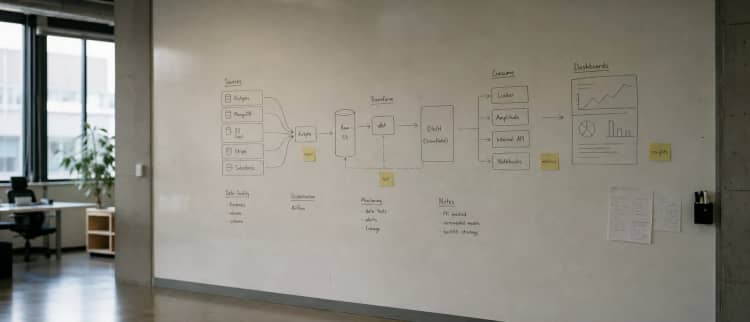
A whiteboard wall with a hand-drawn data architecture diagram.

Why DataDost

Production data work with procurement-grade evidence.

A disciplined path from scattered tools to a foundation leadership can defend: trusted pipelines, metrics that survive audit, and the handover evidence to operate them after launch.

SourcecontractRunlogQualitygateMetricdefinitionRunbookEvidence before trustA dashboard is the visible layer. The evidence workflow is what makes the number safe to use.

Source reliability

Pipelines with owners, SLAs, and runbooks.

We connect the systems that run the business, define load contracts, monitor freshness, and document recovery paths so reporting does not depend on manual exports.

Metric trust

One definition layer for leadership decisions.

Revenue, product, operations, and finance views are built from agreed grains, filters, owners, and caveats so teams stop debating which spreadsheet is true.

AI control

LLM workflows with review and auditability.

Document AI and copilots are wrapped on top of trusted data with typed outputs, confidence checks, escalation paths, cost controls, and trace logs instead of vague model demos.

The DostFlow methodology

Six phases. Documented every step.

Discoverysource mappingowner interviewsdata auditArchitectureschema designcost modelRACIBuilddbt modelsorchestrationquality testsObservabilitymonitoringalertslineageHandoverrunbookstraininghypercare

Stack audit and data mapping

Written data architecture diagnostic and pilot recommendation.

Design

Solution Design Review, stack picks, RACI, and sign-off before build.

Build

Weekly sprints, Friday demos, QA gates, and code review.

UAT

Acceptance criteria tested inside a 10-business-day review window.

Deploy

Change ticket, rollback plan, deployment window, and runbook.

Hypercare

30 days of monitoring, check-ins, and Hypercare Closure Report.

How teams start

Different buying paths. One operating wedge.

The commercial path changes by urgency. The requirement underneath does not: the data foundation has to be trustworthy before dashboards or AI workflows become safe.

How teams startReviewAssess the stack and namethe first safe change.Discuss in scopingSprintShip one source-to-decisionpath with evidence.Discuss in scopingRetainerOwn reliability, iteration,and change control.Discuss in scoping
The board number, the AI workflow, and the dashboard tile all fail for the same upstream reason: the source contract was weak.
DataDost operating thesis

Review

Review path

For teams that need a source map, an ownership readout, and a named first step before they buy a build.

  • Source inventory
  • Metric trust review
  • Pilot recommendation

Sprint

Sprint path

For teams that know the first domain and need one governed source-to-decision path shipped properly.

  • Contracts and checks
  • Models and outputs
  • Runbook and hypercare

Retainer

Retainer path

For teams that need ongoing reliability, change control, and controlled extension into AI or more business domains.

  • Named owners
  • Weekly delivery cadence
  • Controlled AI expansion

Source to decision

What AI-ready actually means

The source, contract, model, owner, and caveat layers must all be visible before a buyer should trust AI or automation on top.

Source to decision workflowRaw systemsbilling, crm, productContract checksschema, freshness, ownershipModelsmarts, metrics, caveatsDecisionsdashboard, ai, operator view

Technology ecosystem

Tools we can build around without turning the site into a logo wall.

The exact stack is selected during discovery, but serious data work usually touches warehouses, orchestration, transformation, streaming, observability, and infrastructure-as-code.

Warehouse and lakehouse

SnowflakeBigQueryRedshiftDatabricksDelta LakeApache Iceberg

Orchestration and streaming

Apache AirflowPrefectDagsterApache KafkaApache Flink

Modeling and quality

dbt CoreGreat ExpectationsSodaMonte CarloPython

Infrastructure and handover

TerraformGitHubRunbooksUAT evidenceIncident notes

Decision lens

What changes once the operating layer exists

The buyer stops asking whether the number is right and starts asking what to do next.

Decision area
Before foundation
After foundation
Board prep
Manual reconciliation and caveat chasing
Reviewed metrics with owner notes and evidence
AI workflow
Prompting on weak or stale data
Running on governed source definitions and controlled outputs
Incident response
Tribal debugging
Named replay path with runbook and owner trail

Delivery patterns

Recurring shapes of the work we ship.

Source mapping, controlled pipelines, dashboards, automation, quality checks, and handover artifacts. Patterns we have built and operated in production.

D2C commerceevidence pattern

Unified order, marketing, and customer data into a cleaner operating view

Delivery evidence pattern

5+

Source families mapped

142

dbt tests deployed

9

Handover artifacts

Read delivery pattern
Finance operationsevidence pattern

Replaced recurring manual reconciliation with controlled data checks and exception reporting

Finance reconciliation operating pattern

5

Run-log fields captured

4

Review states defined

9

Controls documented

Read delivery pattern
Proof pack

Inspect the evidence artifacts behind delivery claims.

Source contracts, metric dictionaries, runbooks, QA notes, UAT evidence, and handover records show how a system is made safe to operate.

Open proof pack

Where the data work usually starts

Operating contexts, not generic industries.

We start from the data sources, decision cadence, risk level, and workflow that make the business hard to run. The vertical matters only after the data problem is clear.

  • SaaS founders need their first unified data stack.
  • Commerce operators need order, ad, inventory, and margin visibility in one place.
  • Finance teams need reconciliation pipelines they can actually trust.
  • Product teams need warehouse-backed event analytics, not screenshot reporting.

The common thread is not the industry. It is the need for a source-to-metric path with written ownership.

See data-system solution paths

Insights

Practical engineering notes for operators

AI integration

How to add LLM features to your product without an ML team

3 min read

Read
Data governance

Lineage for executive dashboards

3 min read

Read
dbt and analytics engineering

Why your dbt project has 200 models and nobody trusts any of them

7 min read

Read
Data operations

Pipeline runbooks that operators actually use

3 min read

Read
Two colleagues collaborating over a notebook and hidden laptop screen while planning a data foundation pilot.

Ship your first data pipeline in 6 weeks.

Start with a free data stack audit. We map your sources, document the gaps, and send a scoped pilot proposal, usually within 48 hours.

Scope a data pilot